

Sam Majid Tells on RegulatingAI Podcast Malaysia Aims to Be a Top-10 AI Nation Through Governance with Sanjay Puri

RegulatingAI Podcast
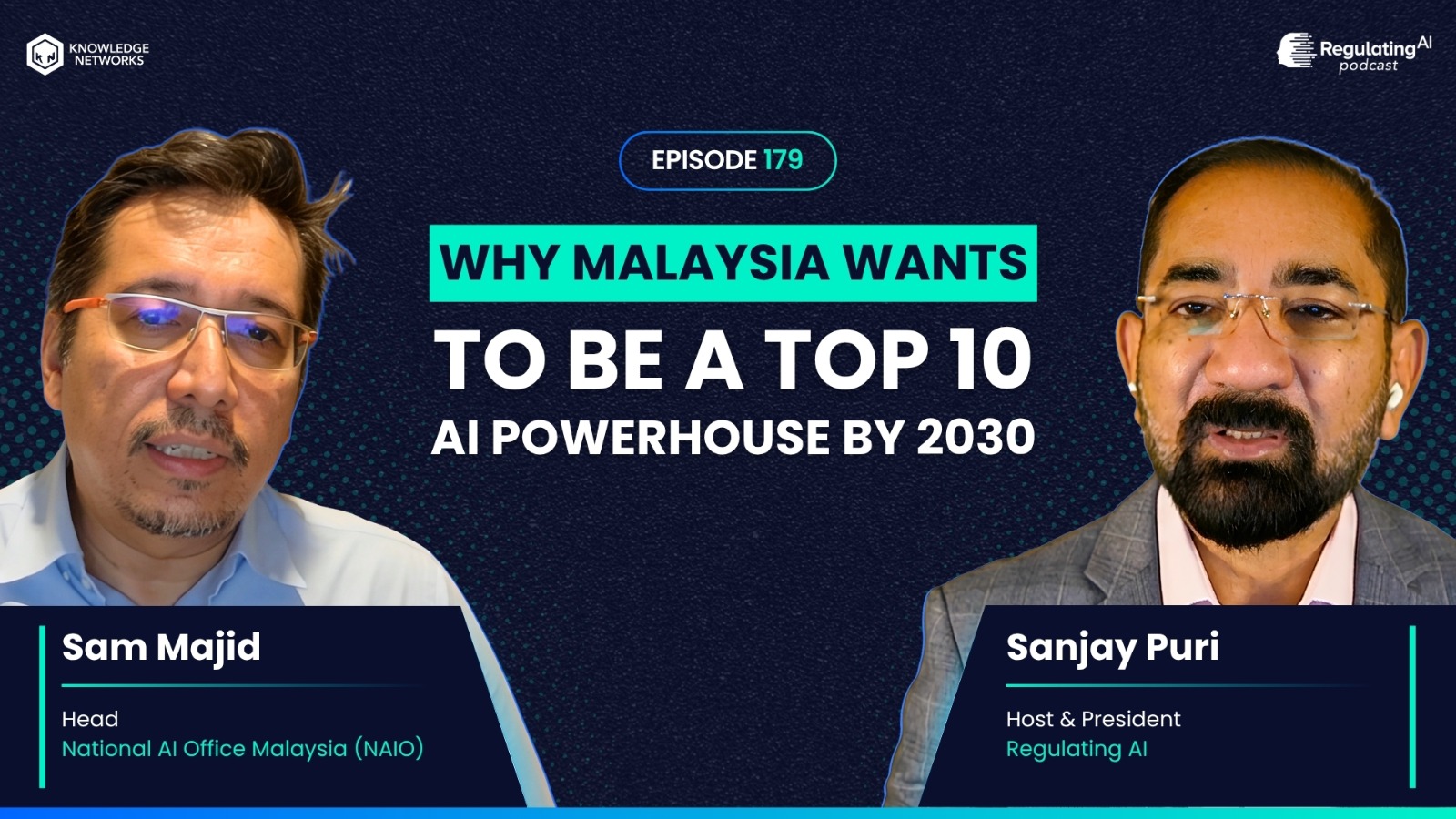
Sam Majid, Head of Malaysia's National AI Office (NAIO) with Sanjay Puri, President of RegulatingAI
On RegulatingAI, Sam Majid shares Malaysia's plan to become a top-10 AI nation by 2030 through governance, AI safety, and inclusive innovation.
Speaking with RegulatingAI Podcast host Sanjay Puri, Sam Majid emphasized that a key element of Malaysia's strategy is collaboration between government and industry. Majid revealed that NAIO has established seven working groups comprising senior private-sector executives and experts who voluntarily contribute to shaping the country's AI future. The initiative reflects Malaysia's belief that AI development cannot be driven by government alone. Industry leaders are being treated as active partners in nation-building, helping create practical frameworks, identify emerging risks, and ensure that AI development remains trusted, inclusive, and aligned with national priorities. This approach has also helped bridge the often-contentious debate between regulation and innovation, with Malaysia pursuing both simultaneously through its AI Nation 2030 blueprint.
During the conversation on the RegulatingAI Podcast, Sam Majid explained that Malaysia's governance philosophy extends beyond global rankings and benchmarks. While the country remains connected to international AI standards, it is also developing domestic measurement systems that reflect its own social, economic, and cultural priorities. According to Majid, relying exclusively on international rankings risks adopting someone else's definition of success. Instead, Malaysia aims to evaluate AI progress based on local realities, workforce needs, and national development goals. The approach reflects a broader trend among emerging economies seeking governance frameworks tailored to their unique circumstances rather than adopting one-size-fits-all models.
Another major topic discussed by Sam Majid with RegulatingAI Podcast host Sanjay Puri was regional cooperation. Malaysia is leading efforts to establish an ASEAN AI Safety Network, a platform designed to facilitate AI safety research, harmonize standards, and promote knowledge sharing across Southeast Asia. Unlike the European Union's centralized regulatory model, ASEAN's approach is expected to preserve national sovereignty while encouraging interoperability and collaboration among member states. The network aims to bring together governments, businesses, academic institutions, and civil society organizations to strengthen AI governance and safety across the region.
Economic inclusion remains at the heart of Malaysia's AI agenda. As highlighted by Sam Majid on the RegulatingAI Podcast, research suggests AI could contribute up to $115 billion to the country's GDP by 2030, but policymakers are determined to ensure that the benefits extend beyond large technology companies and data-center investments. Through AI Nation 2030, Malaysia is prioritizing workforce upskilling, SME enablement, startup development, public-sector transformation, and digital inclusion. The government has already enabled roughly 500,000 public-sector employees to access advanced generative AI tools, helping improve policy development and administrative efficiency. Six priority sectors—agriculture, transportation, education, healthcare, SMEs, and the public sector—have been identified as key areas for AI-driven growth and investment.
Perhaps most notably, Sam Majid told RegulatingAI Podcast host Sanjay Puri that Malaysia's AI strategy places strong emphasis on inclusivity and cultural representation. In a nation characterized by significant ethnic, linguistic, and religious diversity, policymakers are investing in localized datasets, bias testing, and AI systems designed to reflect Malaysian realities rather than relying solely on Western-trained models. The country's governance efforts even extend to AI literacy programs for children, including AI ethics coloring books aimed at building awareness from an early age. As discussed on the RegulatingAI Podcast, Malaysia's ambition to become a leading AI nation is not simply about technological advancement—it is about creating an ecosystem where innovation, governance, diversity, and public trust advance together.
Upasana Das
Knowledge Networks
email us here
Visit us on social media:
LinkedIn
Instagram
Facebook
YouTube
X
Legal Disclaimer:
EIN Presswire provides this news content "as is" without warranty of any kind. We do not accept any responsibility or liability for the accuracy, content, images, videos, licenses, completeness, legality, or reliability of the information contained in this article. If you have any complaints or copyright issues related to this article, kindly contact the author above.
