

From "Sliding Clamp" to Pan‑Cancer Biomarker: How One PCNA Antibody Empowers Multiscenario Research
Multi‑platform Validated Cloud‑Clone PCNA Monoclonal Antibody Supports DNA Metabolism and Translational Cancer Research
HUSTON, TX, UNITED STATES, September 2, 2026 /EINPresswire.com/ -- Proliferating Cell Nuclear Antigen (PCNA) is a core protein governing DNA replication, damage repair and cell-cycle progression, and has long been a key research target in cell biology, oncology and autoimmunity. High-quality, multi-application validated specific antibodies serve as critical experimental tools to unlock the diverse biological functions of PCNA. Cloud-Clone offers its extensively validated PCNA monoclonal antibody product, delivering stable and reliable detection reagents for global researchers to advance basic mechanistic cell-biology studies as well as translational-medicine projects including cancer prognosis and liquid biopsy.
As a central regulator in cellular life activities, PCNA precisely coordinates key processes of DNA replication, DNA repair and cell-cycle progression. First identified as a sliding clamp for DNA polymerase, PCNA is now recognized as a multifunctional molecular hub involved in DNA metabolism and cell-proliferation regulation. Its research potential continues to be uncovered alongside advances in research reagents such as target-specific antibodies.
From “Sliding Clamp” to Molecular Platform: Unravelling PCNA Protein Functions
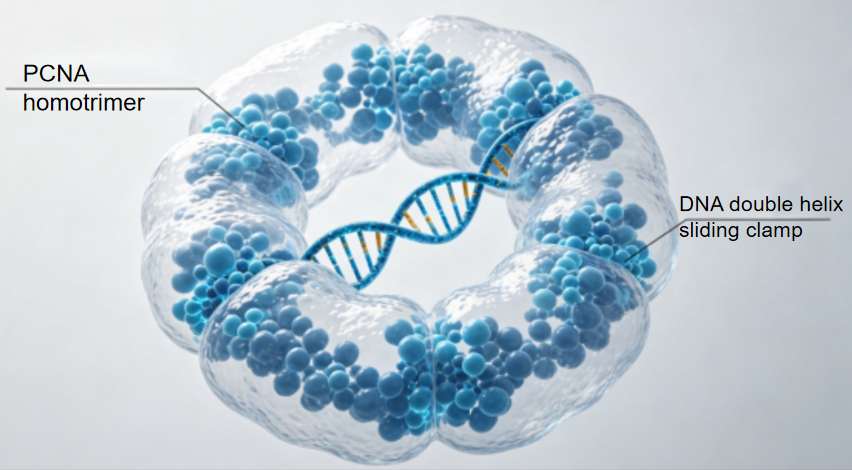
PCNA acts as a core protein within DNA replication and repair pathways. Structurally, three identical PCNA monomers assemble end-to-end to form a ring-shaped homotrimer, which encircles the DNA double helix like a circular sliding clamp. Far from merely attaching to DNA, this structure functions as a dynamic mobile molecular platform. It provides stable binding sites for DNA polymerases δ and ε, sustaining polymerase processivity to enable efficient and accurate genome replication.
Furthermore, PCNA serves as an interaction hub for numerous cellular processes. Its interdomain-connecting-loop (IDCL) surface accommodates dozens of partner proteins carrying PIP-box motifs. Through these physical protein-protein interactions, PCNA participates in Okazaki-fragment maturation, base-excision repair, nucleotide-excision repair, cell-cycle control and chromatin remodelling. PCNA expression levels directly reflect cellular proliferation status. It is highly expressed in rapidly-proliferating cells such as tumour cells and embryonic cells, making it a classic biomarker for assessing cell proliferation.
From Basic Research to Translational Medicine: Diverse Application Value of PCNA Antibodies
Given PCNA’s central position in cellular pathways, highly specific PCNA antibodies are indispensable tools for basic and translational research. Cloud-Clone’s PCNA monoclonal antibody (CAA591Hu22 / MAB231Hu22) has undergone rigorous performance validation across three major experimental platforms.
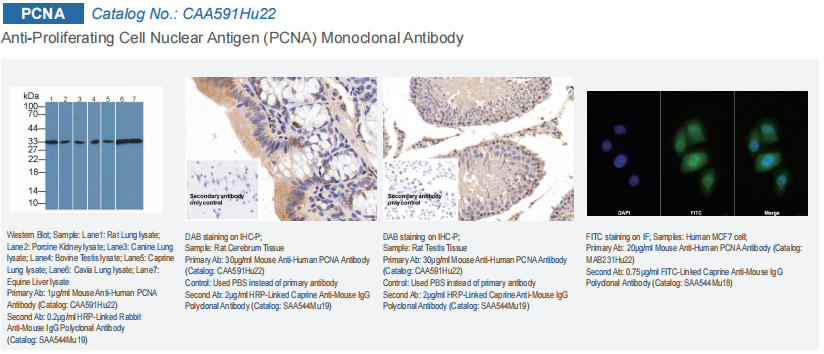
Western Blot: Broad cross-species recognition Western Blot is a classic method to measure PCNA protein expression. At 1 μg/mL primary-antibody concentration, distinct specific bands at approximately 36 kDa were detected in tissue lysates from seven species: rat lung, porcine kidney, canine lung, bovine testis, goat lung and equine liver. These results confirm antibody specificity and the high evolutionary conservation of the PCNA protein. This assay is frequently used to compare protein-expression differences between tumour and adjacent non-tumour tissues, providing reference data for disease-prognosis analysis.
IHC-P: In-situ localization of proliferating cells in tissues DAB-based staining enables visualization of PCNA-positive proliferating cells at tissue-section or even single-cell resolution. In rat-testis tissue sections stained with 30 μg/mL primary antibody, distinct brown nuclear signals were observed in spermatogonia along the basement membrane of seminiferous tubules. The negative control (PBS substituting primary antibody) showed negligible background. This assay is widely used in pathology to evaluate tumour malignancy and proliferation indices, often in combination with Ki-67.
Immunofluorescence (IF): Visualizing subcellular protein distribution When paired with FITC-conjugated secondary antibodies, fine intracellular localization of PCNA can be visualized. In human MCF-7 breast-cancer cells stained with 20 μg/mL primary antibody plus 0.75 μg/mL FITC-labelled secondary antibody, typical granular nuclear PCNA signals were captured with bright signal intensity and low background, consistent with its biological role as a nuclear protein. Cytoplasmic PCNA localization has also been reported in certain studies, offering visual evidence for its non-canonical functions.
Figure 1 Structural model of the PCNA homotrimer encircling DNA
Advanced Research Perspectives: Expanding Research Horizons for PCNA
Beyond conventional molecular-biology experiments, emerging research continues to broaden our understanding of PCNA.
1.Pan-cancer prognostic biomarker: Multiple bioinformatic analyses and clinical studies demonstrate aberrantly high PCNA expression across many cancer types including prostate, lung and liver cancer, correlating with poor patient prognosis. Recent studies report PCNA can be packaged into exosomes and released into peripheral circulation, creating new opportunities for non-invasive pan-cancer screening via liquid biopsy; one published study reports a detection specificity of 94.4%.
2.Potential anti-cancer therapeutic target: Driving tumour-cell proliferation, PCNA represents a promising anti-cancer drug target. Small-molecule inhibitors such as AOH1996 that target PCNA have demonstrated tumour-growth-suppressive effects and enhanced efficacy of existing anti-cancer therapies in vitro and in vivo.
3.Autoimmune-disease research target: PCNA was originally discovered as an autoantigen present in serum from patients with systemic lupus erythematosus (SLE). Investigating immune responses triggered by PCNA and its protein complexes helps decipher the pathogenesis of autoimmune disorders.
PCNA bridges multiple research fields spanning basic DNA-replication-repair studies, tumour pathological evaluation, targeted-drug development and liquid-biopsy research. Rigorously validated PCNA monoclonal antibodies are essential reagents for researchers exploring the full biological potential of this protein.
Figure 2 Anti-Proliferating Cell Nuclear Antigen (PCNA) Monodonal Antibody
Cloud-Clone’s PCNA antibody (CAA591Hu22 / MAB231Hu22) is validated by Western Blot, IHC-P and Immunofluorescence assays and recognizes samples from seven species. Optimized matched secondary-antibody products (HRP- or FITC-labelled, e.g. SAA544Mu19) are available to support stable, reproducible experimental outcomes. Whether investigating DNA-damage-repair mechanisms or identifying novel tumour-diagnostic and therapeutic targets, this PCNA antibody serves as a reliable experimental reagent.
Global researchers can visit Cloud-Clone’s official website to access full validation datasets, product specifications and matching-reagent solutions for this PCNA monoclonal antibody, to drive research advances in cell biology, oncology and autoimmunity.
About Cloud-Clone Corp.
Cloud-Clone Corp. is dedicated to the development and production of high-quality immunoassay reagents and detection solutions. With a focus on antibody engineering, multiplex assay development, and cross-platform compatibility, the company provides research tools designed to support precision medicine and advanced biomedical investigation globally. Our core products and services include the research and development of proteins, antibodies, ELISA kits, primary cells, and multiplex cytokine assay kits, as well as professional CRO services to fully meet the diverse needs of biomedical research and related fields.
For more information about Cloud-Clone Corp, visit www.cloud-clone.com.
CLOUD-CLONE CORP.(CCC)
Tel: 001-832-538-0970, 0086-27-8425-9552
Email: mail@cloud-clone.com, sales@cloud-clone.us
Visit us on social media:
LinkedIn: https://www.linkedin.com/company/cloud-clone-corp/
Instagram: https://www.instagram.com/cloudclonecorp2023/
TickTok: https://www.tiktok.com/@cloudclonecorp2026
SuKi Duan
CLOUD-CLONE CORP.WUHAN
email us here
Visit us on social media:
LinkedIn
Instagram
TikTok
X
Legal Disclaimer:
EIN Presswire provides this news content "as is" without warranty of any kind. We do not accept any responsibility or liability for the accuracy, content, images, videos, licenses, completeness, legality, or reliability of the information contained in this article. If you have any complaints or copyright issues related to this article, kindly contact the author above.
